
FEED365: Tedera Demonstration Site Final Observations

As the FEED365 project draws to a close, ASHEEP & BEEF has some final observations to share on the Tedera demonstration site in Dalyup at The Oaks, hosted by Mitchell and Demi Greaves (JA Russell). This demonstration site was part of the broader Feed365 project, a collaboration between the Department of Primary Industries & Regional Development (DPIRD) and Meat & Livestock Australia. The project’s primary research is being conducted at DPIRD’s Katanning Research Station, aiming to redesign livestock forage systems to fill feed gaps, develop new feed base options and integrate them into grazing systems. We should be able to share information on their findings in early 2026.
The Tedera demonstration site was one of several pasture sites in the Esperance region run in collaboration with ASHEEP & BEEF. More information on the Esperance demonstration sites results (including the pasture mix demonstrations hosted by Josh & Tegan Sullivan at the Esperance Downs Research Station) is available at www.asheepbeef.org.au/feed365.

If you are interested in growing Tedera, DPIRD and MLA have produced a very useful resource “Tedera: A guide to growing this perennial pasture legume”, published in 2023. It covers establishment, grazing management, weed control, diseases and pest control, and seed harvesting. Access it via: https://www.asheepbeef.org.au/_files/ugd/f0422e_26da15ae215d442d942b218c66c40845.pdf
ASHEEP & BEEF thanks agronomist Monica Field (Farm & General) for visiting the Tedera site in May 2025 and providing the following report to capture final agronomic observations.
Tedera Pasture Trial Report – The Oaks (JA Russell)
By Monica Field, Agronomist at Farm & General in Esperance, WA

Introduction
A Tedera (Bituminaria bituminosa var. albomarginata) pasture trial was established in 2022 in Dalyup at The Oaks (a property managed by Mitchell Greaves for JA Russell) to evaluate its potential as a long-term perennial legume in mixed grazing systems. Tedera is noted for its drought tolerance, summer persistence, and capacity to provide green feed during feed gaps. The trial aimed to assess establishment success, weed competition, and plant persistence under broadacre farming conditions typical of the Esperance region. Producers were particularly interested in assessing it in a paddock that was less suitable for cropping. This report reflects my agronomic observations from the trial site and similar properties in the surrounding district.

Site Background
The trial was planted into a long-term pasture paddock located creek-side, with a sloping topography, higher rainfall and little by way of drainage issues, unsuitable for a crop rotation. Site preparation was minimal (initial preparations involved a first knockdown spray on 6/6/22 (3 L/ha Roundup, 1% wetter), a second knockdown on 15/6/22 with insecticide to target redlegged earthmite (2 L/ha Paraquat, 300 ml/ha Le-Mat, 1% wetter), the paddock then sown 16/6/22, followed by pre-emergent herbicides on 17/6/22 (500 g/ha Diuron, 1 L/ha Reflex, 1 L/ha Propyzamide). Redlegged earthmite (RLEM) proved persistent and on 4/8/22 a second insecticide application was delivered (300 ml/ha Le-Mat). While this provided a realistic scenario for broadacre adoption, the lack of targeted weed control and inadequate seedbed preparation negatively affected Tedera establishment. From an agronomic perspective, a more thorough approach to weed and insect management in the year prior would have likely improved outcomes.

The decision was made to spray out the first establishment attempt, and resow. This involved another round of treatments for weed control. These occurred on 22/08/22 (Glyphosate 570 g a.i /ha [Roundup Ultra Max] at 2.5 L/ha), 01/09/22 (2.5 L/ha Paraquat, 25 g/ha Sharpen, 2% Hasten), and on 03/09/22 (pre-emergent, 1 L/ha Propyzamide and 0.5 L/ha of Pyrinex Super to control pests). The Tedera was resown on 6/9/22 at 10.5 kg/ha plus Nodulaid Tedera inoculumn.
Key Observations
Tedera struggled during the establishment phase due to several compounding pressures:
Weed Competition: High weed burdens—including kikuyu, doublegees, geranium, capeweed, melons, and volunteer grasses—significantly reduced initial seedling vigour and ground cover.
Residue Load: Heavy pasture residue reduced seed-to-soil contact, leading to uneven germination.
Insect Pressure: Red-legged earth mites (RLEM) caused early seedling damage, further hindering establishment. There was some budworm pressure late in season also in 2023 and 2024.Despite these challenges, isolated Tedera plants persisted in certain parts of the paddock. However, by May 2025—two seasons post-establishment—very few active plants remained, and ground cover was minimal across the trial area.

Seasonal Conditions and Weather Impact
The trial’s performance must be viewed in the context of the seasonal conditions following sowing. The site experienced two consecutive summers of significantly below-average rainfall, with the Bureau of Meteorology reporting summer rainfall across WA as 20% below the 1961–1990 average—the driest since 2018–2019.
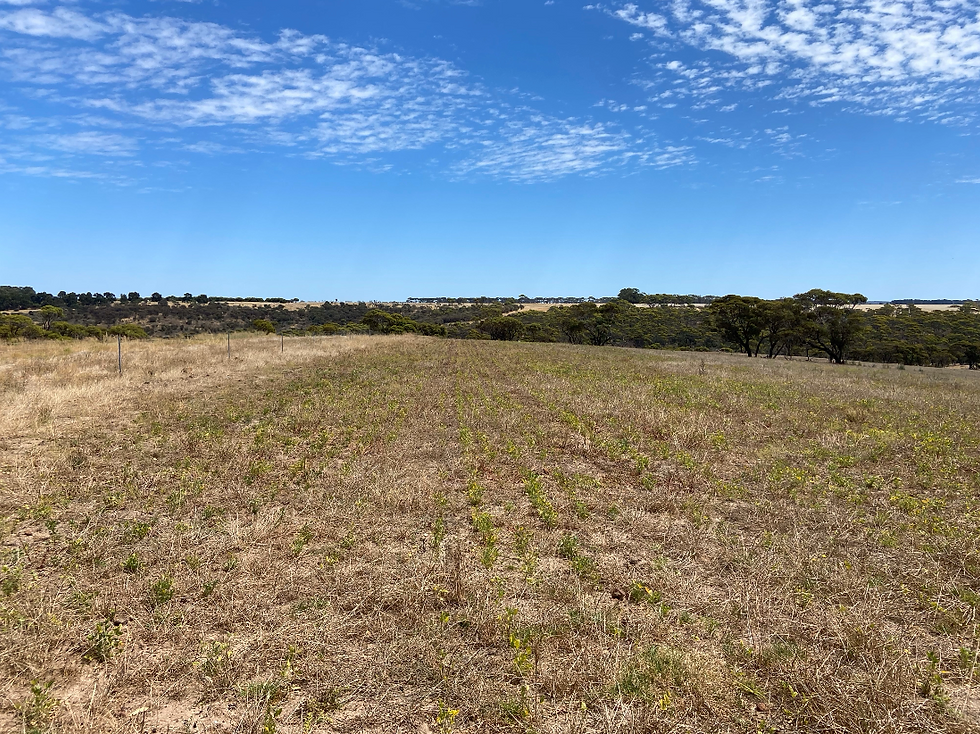
These unusually dry conditions, combined with above-average temperatures, likely restricted root development and carbohydrate storage in Tedera plants, impairing both summer survival and autumn regrowth. The dry conditions also limited natural suppression of weed competition. These climatic challenges reinforce the need for robust establishment practices when trialling perennial pastures in variable rainfall zones.
Comparison to Lucerne in Similar Environments
From my experience observing Lucerne establishment in comparable environments throughout the Esperance region, several notable differences have emerged between Tedera and Lucerne:
Establishment Cost: Tedera establishment remains expensive due to limited commercial seed supply and high seed cost. In contrast, Lucerne seed is more affordable and widely available, and in some cases can be harvested locally to reduce input costs further. It is currently unclear whether this would be feasible for Tedera.
Weed Management and Herbicide Options: Lucerne benefits from a well-established suite of herbicide options, providing effective control of grass and broadleaf weeds. Tedera, on the other hand, has a more limited registered herbicide package [see page 33 of Tedera: A guide to growing this perennial pasture legume for available options], making weed control during establishment a major limitation. This was evident in this trial, where untreated weed burdens significantly compromised the Tedera stand.
Cropping System Fit: Lucerne is often sown under a Clearfield (CL) canola crop, allowing growers to generate income in the establishment year while managing weeds in-crop. Tedera has thus far been sown as a stand-alone pasture, making the first year non-productive and higher-risk, particularly in a dry season.
Adaptation and Known Performance: While Tedera shows promise—particularly for green feed in dry summers—its agronomic package, performance consistency, and long-term benefits are still largely untested in WA systems. Lucerne, by comparison, is well-proven with clear guidelines and known performance under rotational grazing or hay systems.

Conclusions and Recommendations
Although this trial faced considerable challenges and the resulting stand was poor, Tedera remains a pasture species with significant potential in WA’s low- to medium-rainfall zones. Its summer activity and drought resilience make it attractive as a long-term legume option.
Further work is warranted, with future trials ideally focused on:
Reducing seed costs to improve accessibility.
Refining establishment techniques including weed and insect management.
Exploring cropping integration and potential sowing under cover crops.
Quantifying grazing value and comparing long-term productivity and feed quality to other permanent pasture systems.
Continued investment in Tedera research and agronomic development will help determine where this species best fits within WA's farming systems and how its benefits can be fully realised.


Site Host Comments
Monitoring of the Tedera demonstration site has now concluded and ASHEEP & BEEF would like to thank Mitchell and Demi Greaves for hosting the site and their involvement throughout the project. Mitchell provided the following comments in relation to the Tedera’s performance.
“Overall, the Tedera site had a tough life. Throughout the trial there was not much summer rainfall, which challenged its establishment and held back its potential."
"The soil type of the paddock may not have been what it ideally wanted, it is quite hard underneath and the plants struggled to get roots down and as a result did not get much moisture.”
In May 2024, with very dry seasonal conditions in the district, Mitchell observed that the Tedera was coping with the lack of rain better than the lucerne the farm was also growing. The unintended challenge that brought was that temptation was too much - cattle and sheep broke into the paddock and grazed it to the ground, preventing the project’s planned measured grazing. A measured grazing of the site was captured between 12/6/23 - 8/8/23, with the results reported in the 2023 season report available at www.asheepbeef.org.au/post/feed365-demonstration-sites-2023-season-wrap.
“As far as the measured grazing went, I was pretty happy with it. We were able to graze it for a fairly long length of time,” said Mitchell.
“In future I will probably focus on other pasture options, from a cropping rotation point of view. I see the best fit as possibly being a millet over the summer, sown when the opportunity arises. The Tedera takes a year to establish and it can’t be grazed hard which is a limitation."
"The year before the Tedera trial began we established Lucerne on the farm. That season we had a soft finish, the Lucerne was sown in August and we were able to graze it by late December. The establishment season clearly makes a big difference.”


